Which type of water heater fits your household: a tank or a tankless unit? The answer comes from how your home uses hot water, not from which type is newer. A family that runs showers, laundry, and a dishwasher in the same hour has different needs from a couple who never overlap. Black Plumbing, a family-owned company founded in Abilene in 1994, serves Snyder as part of our service area, and our team is available 24/7. This guide helps Snyder homeowners match the heater to the household.
How each type works
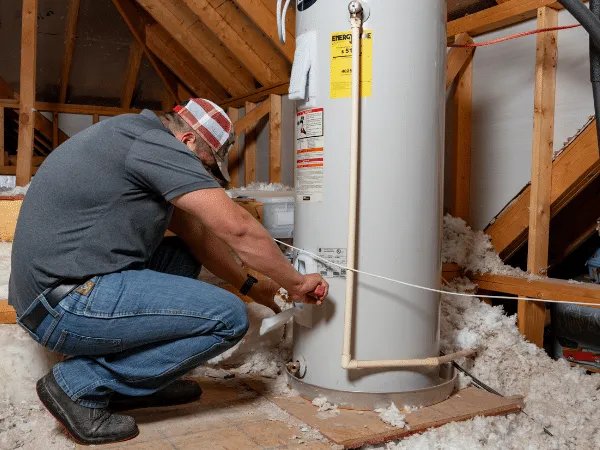
A tank heater, also called a storage heater, keeps a supply of hot water ready in an insulated tank. When you open a tap, hot water leaves the tank and cold water refills it. The burner or elements cycle on to hold the temperature. That is simple and familiar.
A tankless heater, also called an instantaneous or on-demand heater, has no storage tank to speak of. When you open a hot tap, water flows through a heat exchanger and is heated as it passes. When the tap closes, the heater stops.
ENERGY STAR draws the line in numbers. On its water heater key product criteria page, it describes tankless units as those that contain no more than one gallon of water per 4,000 Btu per hour of input. Everything else in the storage category holds a tank of heated water.
The number that matters for each type
Each type is rated on a different yardstick, and that is where many homeowners get stuck.
Tank heaters: first hour rating
The ENERGY STAR page defines the first hour rating as an estimate of the maximum volume of hot water, in gallons, that a storage heater can supply in one hour that begins with a fully heated tank. If a morning rush in your house uses more hot water than that number, the last person in line gets lukewarm water.
Tankless heaters: gallons per minute
For a tankless unit, the same page defines gallons per minute as the amount of hot water the unit can supply while keeping a steady temperature rise. The limit is flow, not volume. A tankless unit can run as long as you like, but it can only heat so much water at once. Run two showers and a dishwasher together, and the flow may exceed what one unit can heat.
Efficiency: uniform energy factor
Both types also carry a Uniform Energy Factor, which ENERGY STAR describes as the measure of a water heater’s overall efficiency. A higher number means a more efficient heater. Use it to compare models within a type, and be careful comparing a tank number against a tankless number without looking at the whole picture of your usage.
Questions that decide it
Work through these before you pick.
- How many people use hot water at the same time? If peak use is one or two taps, a properly sized tankless unit can keep up. If three or four things run together, a tank or a larger tankless setup may suit better.
- What fuel do you have? Gas and electric units behave differently. Tankless gas units need adequate gas supply and venting. Tankless electric units need substantial electrical capacity.
- Where does the heater sit? Tanks need floor space and clearance. Tankless units mount on a wall and take less room, but they need venting or electrical service in that spot.
- How long will you stay? A longer plan for the house gives tradeoffs more time to pay off. A short plan often favors the simpler choice.
- Do you want to avoid the run of cold water at the start? Tankless units heat on demand, but hot water still has to travel through the pipes. Distance from heater to tap affects how long you wait.
Three example households
These are illustrations, not customer stories. They show how the same questions lead to different answers.
A busy family of five
Mornings are crowded: two showers, a load of laundry, and the dishwasher all running before school. Hot water demand arrives in a big block. A tank heater with a first hour rating that covers that block is a natural fit. A tankless unit would need to be sized for the peak, and the household would need to accept that a very large unit may call for upgrades to gas or electric service.
A couple with staggered routines
One person showers early, the other later, and the dishwasher runs at night. Demand is small and spread out. A tankless unit sized to one or two fixtures at a time suits this pattern well, and it does not keep stored water hot all day.
A household with a long pipe run
The heater sits at one end of the house and the main bathroom at the other. Either type will take time to deliver hot water to the far tap, because the cold water already in the pipe has to clear first. Neither heater type fixes that. If it bothers you, a plumber can look at the layout of the lines, and sometimes a heater in a different spot helps.
What a tank heater does well
- It supplies a large volume at once, up to the first hour rating, which suits busy households.
- It is a familiar design, and most plumbers can service it.
- It often fits into the space and connections that already exist, which can simplify a swap.
- It keeps working through short, large demands that would exceed a small tankless unit’s flow.
The tradeoffs are floor space, the energy used to keep stored water hot, and the fact that a tank has a finite working life. See our guide on repairing or replacing a tank heater if you are looking at an older one.
What a tankless heater does well
- It does not keep a tank of hot water waiting, so it is not heating water you are not using.
- It takes less space and mounts on a wall.
- It can supply hot water for as long as the tap is open, within its flow limit.
- Many models are rated at high efficiency numbers.
The tradeoffs are the flow limit, the possible need for gas line, venting, or electrical upgrades, and more complex parts. A tankless unit needs its own upkeep as well. Our tankless water heater repair page covers the service side.
Replacing a tank with a tankless unit
Switching types is a bigger job than swapping like for like. A plumber looks at several things before recommending it:
- The size of the gas line or the capacity of the electrical panel.
- Whether there is a route for venting that meets code.
- The location, including clearance and access for service.
- The home’s peak hot water use, so the unit is sized to it.
- The condition of the water lines that will connect to it.
If any of these call for changes, they should be explained before work starts, and the decision is yours. Our water heater service covers both types.
What a sizing conversation covers
A licensed plumber helping you choose would generally work through these points:
- How many people live in the home and how they use hot water.
- The current heater, the fuel supply, the venting, and the space.
- Which types are a good fit and which are not, and why.
- Your choice, then scheduling the work.
- After installation, a test of the heater and a walk-through of its operation.
Our licenses are Texas plumbing license M-40900 and Texas HVAC (ACR) license TACLA145786C.
Frequently asked questions about tank and tankless water heaters in Snyder
Can a tankless heater supply a whole house?
It can, if it is sized for the household’s peak demand. The limiting factor is flow. A unit that is too small will give you a drop in temperature when several fixtures run together. Sizing matters more than the type.
Is a tankless heater always more efficient?
Not automatically. Efficiency depends on the model and on how you use hot water. Compare the Uniform Energy Factor on each unit, and think about your own pattern of use instead of relying on a general claim.
Will a tankless unit fit where my old tank is?
Sometimes. The space may be fine, but gas supply, venting, or electrical service may need changes. That is why the location should be checked before a switch is recommended.
What if I choose one and it does not suit us?
That is why the first step is looking at your actual use. If the match is right, the type you pick will meet the need. If you are not sure, ask a plumber to weigh the tradeoffs with you before you commit. For routine care on whichever type you choose, see our post on yearly water heater checks.
Talk through the choice with us
If you are deciding between a tank and a tankless heater in Snyder, we can look at your home and walk through the options. Use our service scheduling page to set up a visit, or learn more about the area we cover on the Snyder service page.