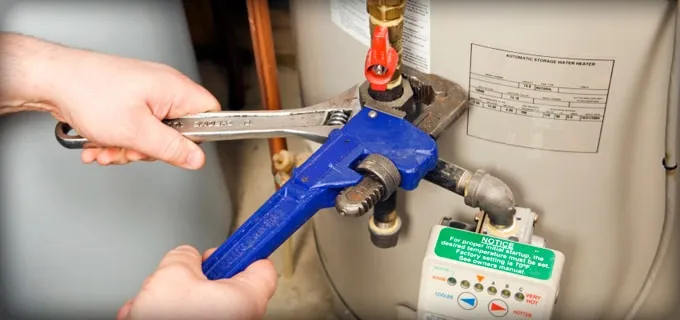
Which water heater symptoms point to a repair, and which mean the unit is finished? That is the question at the center of a hot water call in Abilene. Lukewarm showers, a rumble from the tank or a puddle on the floor all feel urgent. They do not all mean the same thing. This guide sorts the common symptoms by what usually causes them and what the fix looks like, so you can walk into the conversation with a technician knowing what to ask. Black Plumbing Heating & Air has served Abilene since 1994 from 4402 S Danville Dr, and our plumbers take calls 24/7.
Tank or tankless: the first thing to know
The symptoms depend on the type of water heater you own. ENERGY STAR’s residential water heater criteria describe the difference. Storage-type units heat and store water at a thermostat-controlled temperature. Instantaneous, or tankless, units heat water as it flows and hold very little, no more than one gallon per 4,000 Btu per hour of input. A tank can fail by leaking, building up sediment or losing a heating part. A tankless unit has no tank to rust through, and tends to fail in other ways, such as scale on internal parts or faults that show up as error codes.
Our Abilene hub describes this pattern. Sediment, a failed element or an ignition problem causes most tank water heater calls, and tankless units fail differently, usually from scale. Hard water is standard in this part of Texas, according to the hub, and it leaves scale inside water heaters. Keep that in mind as you read the signs below.
Symptoms that usually mean a repair
No hot water at all
On an electric tank, a failed heating element or a tripped thermostat limit is a typical cause. On a gas tank, the pilot or igniter, a faulty thermocouple or a gas supply problem can be the cause. Check that the breaker has not tripped or that the pilot has not gone out, but do not take panels apart. If you smell gas, leave the house and call from outside.
Water that is warm but never hot
When the water never gets hot enough, a failed lower element on an electric tank or a dirty burner on a gas tank is a common culprit. Sediment in the bottom of the tank can also insulate the water from the heat. A repair visit can test the parts and say which one failed.
Hot water that runs out fast
If the supply fades sooner than it used to, sediment may be taking up space in the tank, or a dip tube or element may be failing. Flushing and replacing a part can restore performance in many cases. If the tank is old and has other problems, the technician may recommend replacing it instead.
Rumbling, popping or knocking
Those noises usually come from water trapped under a layer of sediment and boiling as the burner or element heats it. The sediment is a sign that scale has built up inside. A flush can help, though heavy buildup can be a sign the tank is wearing out.
The pilot light keeps going out
A pilot that will not stay lit may point to a dirty or failing thermocouple, a draft or a gas valve problem. Do not keep relighting it if it fails again and again. Call a technician.
A tankless unit showing an error code or a drop in flow
Scale can clog the heat exchanger and flow sensors. The unit may shut off, deliver lukewarm water or display an error code. Descaling often restores operation, and a technician can read the code and tell you what it means. Our tankless water heater repair service covers this work.
Symptoms that raise the replacement question
Water leaking from the tank itself
Check where the water comes from. A drip at a pipe connection, the pressure relief valve or a drain valve can often be fixed. A relief valve that drips should be checked by a technician, and it must never be capped or plugged. Water that is seeping through the tank wall or pooling under the unit with no fitting at fault means the tank has failed internally, and no part can fix that. Shut off the water supply to the heater and the power or gas, and call.
Rust-colored hot water
If rust shows up only in hot water, the inside of the tank may be corroding. A failed anode rod can speed corrosion, and replacing it can help if the tank is otherwise sound. If the tank wall has already rusted, repair will not reverse it.
Repeated repairs
One failed element is a normal repair. A series of failures, each soon after the last, suggests the system is worn. Our hub says a good technician will tell you when a repair is a waste on a tank that is nearly done. That is the standard to expect.
Scale and sediment that will not clear
Heavy mineral buildup, especially in a place with hard water, can shorten a tank’s life and make it inefficient. If a flush does not clear it, you may be looking at replacement. Our hub notes that hard water leaves scale inside water heaters, and water filtration sized to the household is one option to ask about. See our page on water heater repair and replacement to learn how we approach both options.
What to do first when something goes wrong
- If there is a gas smell, leave and call from outside.
- If water is leaking, shut off the cold water supply to the heater and the power or gas.
- If water is spreading across the floor, shut off the main water valve.
- Do not touch electrical parts with wet hands or while standing in water.
- Note the symptoms, when they began and anything that changed beforehand.
Our emergency plumber service is available around the clock for a heater that is leaking badly or has failed on a cold morning.
Questions to ask before you approve a repair
A short list keeps the conversation useful, whatever the diagnosis turns out to be:
- What failed, and can you show me the part?
- Is that the only problem, or is the failure a sign of something wider, such as heavy sediment?
- If we repair it, what else is likely to wear out next?
- If we replace it, what are the choices for a household like mine?
- What would you do if this were your own water heater?
The last question is a good test. An honest technician will answer it plainly. The goal is not to win an argument about repair versus replacement. It is to leave you with hot water and a decision you understand.
Choosing between a tank and a tankless replacement
If the answer is replacement, you will face the tank or tankless choice. A tank stores a supply of hot water, so it can serve several fixtures at once up to its capacity, then needs time to recover. A tankless unit heats water on demand and does not run out in the same way, but it has limits on how much flow it can heat at once, and it needs scale control in hard-water areas. Household size, how many fixtures run together, gas or electric supply and venting all matter. The ENERGY STAR criteria page mentioned above explains that certified water heaters must meet efficiency requirements, so ask whether a model you are considering carries the label.
A technician who has seen your house can tell you what fits. You do not need to decide in advance. Bring your questions and your habits: how many people shower in the morning, whether the laundry runs at the same time, and how long the hot water has to travel to the farthest bathroom.
What we do on a water heater visit
The technician starts by asking what you noticed, then checks the symptoms against the unit: power or gas supply, controls, heating parts, venting, connections and the tank. They explain the cause and the choices. If a repair is sensible, we describe it. If the unit has reached the point where repair makes little sense, we say that and explain the replacement options, including whether a tank or a tankless unit fits your household. The decision is yours, and nothing is added without asking.
Care that helps between visits
- Look at the unit and the floor around it regularly for drips, rust or dampness.
- Keep the area clear so a technician can reach it, and so a leak shows up quickly.
- Ask about flushing the tank, which removes sediment. In a hard-water area, sediment is a real concern.
- For a tankless unit, ask about descaling to remove mineral buildup.
- Ask about water filtration if scale keeps returning.
Abilene homes and water heater location
In older Abilene houses, the heater may sit in a closet, an attic or a garage that was altered over the years. Our hub notes that older homes can have original shutoff valves that no longer close. Before you need to, find the shutoff on the water line feeding your heater and check that it turns. If it does not, say so when you call, so we can plan for it.
Get hot water back in Abilene
Our Abilene office is rated 4.8 out of 5 on Google. To see everything we handle locally, visit the Abilene service hub. To describe your water heater problem or book a visit, call (325) 675-8391. We hold Texas plumbing license M-40900, and our office is at 4402 S Danville Dr, Abilene, TX 79605.