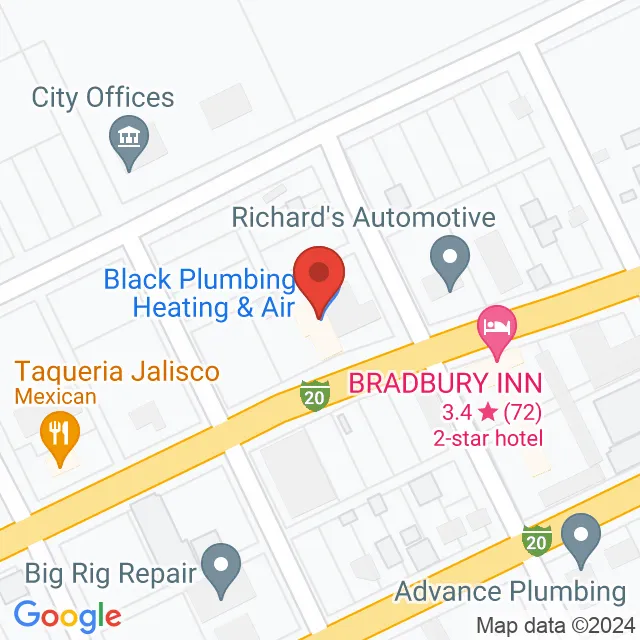
Some HVAC problems are obvious. The air conditioning (AC) stops, or the furnace stays silent on a cold morning. Many are not. One bedroom is warmer than the rest, the air smells stale, or the system runs all day and never quite catches up. If you live in San Angelo and are not sure which kind of HVAC service your symptom calls for, this guide maps what you notice to the work that fits it. Black Plumbing Heating & Air handles heating, cooling, and indoor air from our office at 501 N Main St, and we are open 24/7.
Start with what you notice, not what you think is broken
It is easy to name a part before describing a symptom: “I think it’s the compressor” or “I need a new thermostat.” The part may be right, but the symptom is more useful to a technician because several different faults can produce the same behavior. A house that will not cool might have a refrigerant problem, a failed electrical component, a blocked airflow path, or a system that is simply too small for the home. Describing what you see, hear, and feel lets the technician test the right possibilities in the right order.
The sections below group common symptoms by the service that usually applies. Treat them as a starting point, not a diagnosis.
Symptom: the house is not cooling
This is the classic summer complaint, and the cause varies. Warm air from the vents, a system that runs without lowering the temperature, or a unit that will not start at all all point toward air conditioning repair in San Angelo. Our hub page lists the usual suspects for this service: refrigerant leaks, failed capacitors, and airflow problems. A technician checks each in turn rather than guessing.
If the system cools but cannot keep up, or it has needed several repairs, the question changes from “what failed” to “is this system still worth repairing.” That is a conversation about the age and condition of the equipment, which belongs under air conditioning replacement. We lay out both the repair and the replacement route so the decision is yours.
Symptom: the house is not heating
Furnaces in San Angelo sit idle for much of the year, as our hub page notes, and they can fail quietly the first time you need them. Common signs include no heat from the vents, a furnace that starts and shuts off, a blower that runs without warm air, or a pilot or ignition that will not stay lit. These belong with emergency heating repair, which is available around the clock. Troubleshooting covers ignition problems, blower issues, and heat pumps.
One safety point matters here. If a gas furnace smells wrong, or anyone in the home has headaches, dizziness, or nausea while the heat is running, leave the house and call for help. Carbon monoxide, a gas that is colorless and practically odorless, can come from leaking furnaces and chimneys and from back-drafting appliances, so a furnace you are worried about deserves a prompt look.
Symptom: some rooms are comfortable and others are not
Uneven temperatures are often an airflow problem, not an equipment failure. Ducts that run through an attic, crawl space, or garage can leak or lose conditioned air before it reaches a room. The ENERGY STAR program notes that sealing and insulating ducts can improve a system’s efficiency by as much as 20 percent, and recommends focusing first on ducts that run through the attic, crawlspace, unheated basement, or garage. You can read that advice on its heating and cooling guidance page.
Our hub page makes a related point about older San Angelo homes: many were built before central air was standard and can have thin ductwork or limited attic space. That does not mean the house is a problem. It means a technician should look at the ducts and the layout as part of any comfort complaint, not only the equipment outside.
Symptom: the air feels stale, dusty, or off
When the thermostat reads fine but the air does not feel right, the right service is often indoor air quality solutions. Dust, odors, and humidity problems have causes inside the house and inside the duct system. The EPA’s guidance on improving indoor air quality describes three basic strategies: source control, improved ventilation, and air cleaners or filtration. A good technician starts with what is producing the problem before recommending any equipment.
If you want the longer version, our post on enhancing indoor air quality in San Angelo homes goes through each of those strategies.
Symptom: it works, but you want it to keep working
Nothing is wrong yet, and you would like to keep it that way. That is the case for air conditioning maintenance. ENERGY STAR recommends having a contractor do annual pre-season check-ups, and notes that contractors get busy once summer and winter arrive, so the cooling system should be checked in the spring and the heating system in the fall. Its maintenance checklist lists tightening electrical connections, checking the condensate drain, cleaning coils, checking refrigerant level, and cleaning blower components for cooling, and checking gas connections, burner combustion, and the heat exchanger for heating.
That list is worth reading even if you never hire anyone, because it shows what a real tune-up involves. A visit that skips most of it is not a tune-up.
Symptom: it is a business, not a house
Offices, shops, and restaurants have different loads, and a failure can interrupt a day of work. For those buildings, we handle commercial HVAC repair and installation in San Angelo, including rooftop unit service and after-hours repairs.
Where the services overlap
A single house can raise several of these symptoms at once, and that is why one team handling heating, cooling, and air quality is useful. Our broad category page for HVAC repairs and installation is the place to start when you cannot tell which symptom matters most. A technician who sees the whole system can notice, for example, that a weak airflow complaint and a stale smell come from the same dirty filter or blocked return, instead of treating them as two unrelated jobs.
ENERGY STAR gives a simple do-it-yourself step that helps with several symptoms at once: inspect, clean, or change air filters once a month in a central air conditioner, furnace, or heat pump. A dirty filter slows airflow, makes the system work harder, and lets dust and dirt build up inside it. Check yours before you assume something bigger is wrong.
What happens when you call
The process is the same whichever symptom brought you to us:
- You describe what you see. Tell us what the system does and when it started. Photos of a thermostat display or an error code help.
- A technician is scheduled. For heating or cooling failures, that includes nights and weekends, since we are open 24/7.
- Inspection. The technician checks electrical connections, airflow, refrigerant or combustion as the system requires, and the thermostat and controls.
- Explanation and options. You hear what was found and the choices available, and you decide.
- Repair and testing. The system is run through a full cycle to confirm the symptom is gone.
How to describe a problem so it gets solved faster
- Say when you first noticed it and whether it comes and goes.
- Note which rooms are affected, and whether the problem changes with the time of day.
- Mention any recent work on the system, house, or attic.
- Write down any sounds or smells and where they seem to come from.
- Have the age of the equipment ready if you know it.
None of this requires technical knowledge. It simply gives the technician a better first question to answer.
Choosing the right time to call
Many symptoms leave a window to plan. A room that runs slightly warm, a filter that needs changing, or a system that is overdue for a check can be scheduled on a calm day. Others do not wait: a gas smell, a burning odor, a breaker that keeps tripping, or no heating or cooling when someone in the home is vulnerable to the weather. When you are unsure which group your symptom belongs to, call and describe it. Our team will tell you whether it needs attention now or can be booked as a normal visit, and we can send a technician at any hour if it cannot wait.
Matching the service to the symptom is only the first step. The second is giving the technician the whole picture, including what changed recently and what you have already tried, so the visit starts from facts instead of guesses.
What a San Angelo customer says
A customer review from October 2026 sums up what we aim for on every call. Mitt R., a San Angelo customer, wrote: “We’ve used them several times here in San Angelo and highly recommend them.” Repeat service is a useful measure of how a visit went, and it is the standard we try to meet.
Ready to talk it through
If you know your symptom, you can call our San Angelo team directly at (325) 659-3747, or visit 501 N Main St, San Angelo, TX 76903. You can also see our full range of plumbing and HVAC work on the San Angelo hub page. We are open 24/7, so a symptom that appears at night does not have to wait for morning.